
CLEAR study seeks UK participants to investigate restoring hypo awareness

A major international trial is recruiting people with type 1 diabetes to investigate whether diabetes technology, psychoeducation or a combination of the two is most effective at restoring impaired awareness of hypoglycaemia.
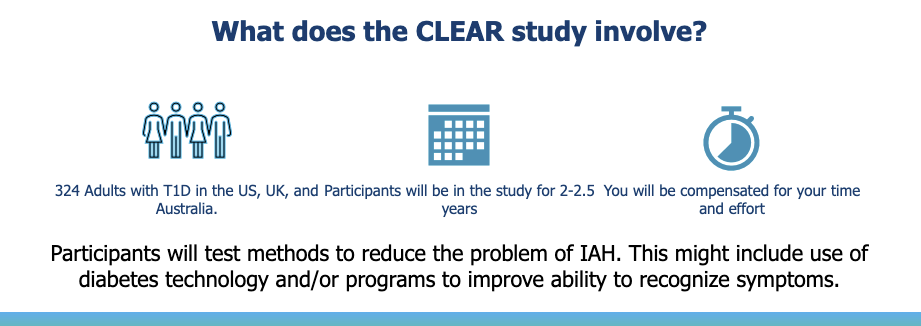
The CLEAR study is a multinational randomised controlled trial involving eight sites across the UK, US and Australia, with a recruitment target of 324 participants. UK recruitment is taking place in Leicester and Sheffield, where researchers are keen to reach more people who may be eligible for the study.
Impaired awareness of hypoglycaemia (IAH) occurs when people no longer experience some or all of their usual warning symptoms of low glucose or only notice symptoms at a lower glucose level than previously.
It can develop following repeated episodes of hypoglycaemia and substantially increases the risk of problematic and severe hypoglycaemia. The consequences can extend to driving, employment, sleep, exercise, confidence and quality of life.
Although continuous glucose monitoring and hybrid closed-loop (HCL) systems can reduce hypoglycaemia, impaired awareness can persist despite the use of advanced technology.
The CLEAR study hopes to discover whether HCL technology can actually restore the body’s natural warning system rather than simply reduce exposure to hypoglycaemia and how its effects compare with established psychoeducational interventions.
Participants may receive HCL technology, psychoeducation or a combination of the two. The psychoeducational approaches include MyHypoCOMPaSS, which helps people identify subtle physical and behavioural cues associated with hypoglycaemia, and HARPdoc, which addresses beliefs, assumptions and behaviours that may contribute to severe hypoglycaemia and impaired awareness.
A particularly important feature of CLEAR is how researchers will determine whether awareness has genuinely returned.
Rather than relying solely on CGM data or participants reporting fewer hypos, the trial uses controlled glucose clamp studies. During these assessments, researchers measure symptoms alongside physiological responses including adrenaline and glucagon, as well as cognitive function, at different glucose levels. This allows the team to examine whether the body’s natural defences against hypoglycaemia are recovering.
Researchers also hope CLEAR will establish whether different people require different approaches to treatment.
Factors including age, duration of diabetes, previous hypoglycaemia and individual behaviours could influence response to treatment. Identifying predictors of response could ultimately help clinicians determine who is most likely to benefit from technology, psychoeducation or a combination.
HCL systems are currently the main routinely available intervention for IAH, while programmes including MyHypoCOMPaSS and HARPdoc have more limited availability. If CLEAR demonstrates additional benefit from psychoeducation, researchers hope such interventions could become more widely accessible and enable treatment to be better tailored to individual patients.
Recruitment remains open. Sheffield has recruited 30 participants towards a target of 40, while Leicester is approaching 15 participants.
Potential participants must be aged between 18 and 75, have lived with type 1 diabetes for at least 10 years and have evidence of impaired awareness of hypoglycaemia. People already using CGM, insulin pumps or HCL systems are also eligible.
The team hopes to complete recruitment across all sites by July 2027, with participants then followed for a further two years.