
Diabetes quadruples in 35 years

The number of people who were living with diabetes has almost quadrupled largely down to “obesity”, according to the World Health Organization (WHO).
In its first-ever report on the disease the UN agency said the figures reflect “an increase in associated risk factors such as being overweight or obese” across 35 years.
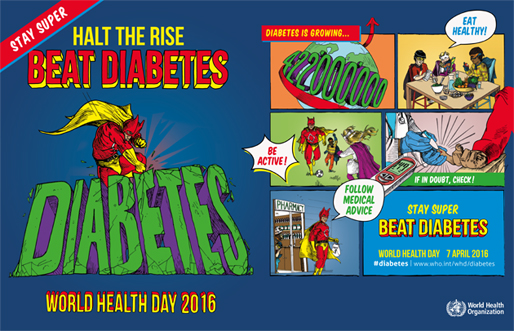
The data was reported in the WHO Global Report on Diabetes for World Health Day 2016 and was published in The Lancet.
It stated that since 1980, the number of adults with diabetes worldwide has increased from 108 million to 422 million in 2014.
Diabetes caused 1.5 million deaths in 2012 and high blood sugar levels caused an additional 2.2 million deaths, by increasing the risks of cardiovascular and other diseases.
Forty-three percent of these 3.7 million deaths occur before the age of 70.
The region worst affected, with 131 million estimated cases in 2014, was the WHO’s Western Pacific region, which includes China and Japan.
‘Critical window’
The Southeast Asia region – which includes heavily populated India and Indonesia – was the next most affected, with 96 million cases.

Obesity is being blamed for a large rise in type 2 diabetes
Europe and the Americas were third and fourth on the list, with 64 million and 62 million cases respectively
The WHO has urged countries to take a “series of actions”in order to reduce the impact of the condition.
Some of the recommendations include addressing key gaps in diabetes knowledge, prioritising obesity prevention from an early age and implementing guidelines to improve diagnosis and management in primary healthcare.
The report said there was a “critical window for intervention” in order to mitigate the risk of obesity and type 2 diabetes later in life.
Professor Majid Ezzati, senior author from Imperial College London, said: “Diabetes has become a defining issue for global public health. An ageing population, and rising levels of obesity, mean that the number of people with diabetes has increased dramatically over the past 35 years.
“Obesity is the most important risk factor for type 2 diabetes and our attempts to control rising rates of obesity have so far not proved successful. Identifying people who are at high risk of diabetes should be a particular priority since the onset can be prevented or delayed through lifestyle changes, diet or medication.”
A staggering four million people are currently living with diabetes in the UK, of which an estimated 549,000 people have type 2 diabetes but do not know it as they have not yet been diagnosed
It noted that spreading consumption of sugary drinks and other fattening foods was a key factor, but drew particular attention to high rates of physical inactivity.
According to worldwide 2010 figures, nearly a quarter of people over 18 did not do the minimum recommended amount of physical activity per week, with women recorded as less active than men.
The WHO recommends that adults get at least 150 minutes of moderate physical activity, including things like walking, jogging and gardening, per week.
The report said: “Physical inactivity is alarmingly common among adolescents.” noting that the excessively sedentary lifestyles were more acute in high-income countries than low income countries.
Libby Dowling, senior clinical advisor at Diabetes UK, said: “A staggering four million people are currently living with diabetes in the UK, of which an estimated 549,000 people have type 2 diabetes but do not know it as they have not yet been diagnosed.
“It is estimated that, if nothing changes, five million people in the UK will be living with the condition by 2025, making the need to tackle this serious health condition more urgent than ever.
“While this study attributes the increase in diabetes prevalence in Western Europe in part to an ageing population, it is crucial that we recognise the most important risk factor for type 2 diabetes which is being overweight or obese – almost two in every three people in the UK are overweight or obese and therefore at increased risk of type 2 diabetes.”