
Experts warn of missed opportunities to detect kidney disease in people with diabetes

Thousands of people living with diabetes could be missing out on early detection of chronic kidney disease because of low uptake of a simple urine test, kidney health experts have warned.
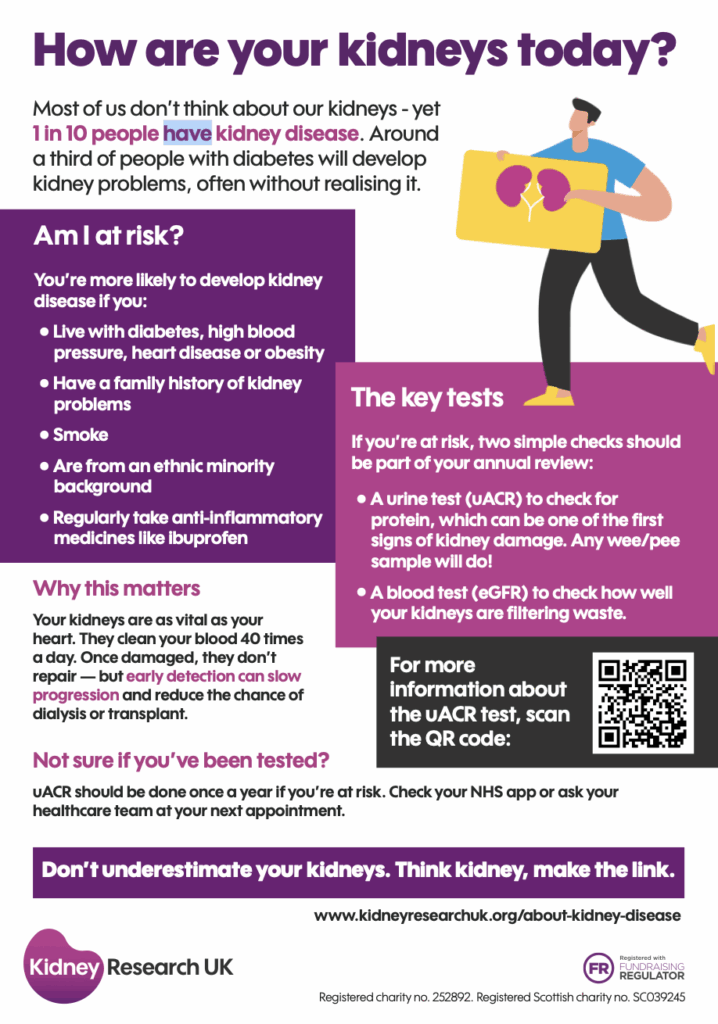
Despite being a recommended part of routine diabetes care, the urine albumin-to-creatinine ratio (uACR) test remains the least frequently completed of the nine key diabetes care processes, raising concerns that opportunities to prevent serious kidney and cardiovascular complications are being missed.
In a new article published in Diabetes & Primary Care, experts from Kidney Research UK have highlighted the importance of improving access to uACR testing, particularly for people living with diabetes, high blood pressure or cardiovascular disease.
The article, Kidney health checks: Whose role is it anyway?, written by Dr Zoe Markham-Lee, Research Programme Manager Kidney Research UK and Swati Bhagat-Jones, Multiple Long-Term Conditions Team, Kidney Research UK, examines why kidney health checks are essential, the barriers preventing patients from receiving them and what primary care teams can do to improve testing rates.
Figures from the National Diabetes Audit for 2024–25 reveal that while 91.9% of people with type 2 diabetes received an HbA1c blood test, only 68.6% had their uACR measured.
The situation was worse for people with type 1 diabetes, with just 54.8% receiving the test.
These findings are particularly concerning because chronic kidney disease (CKD) often develops without noticeable symptoms, meaning damage can progress before patients become aware that anything is wrong.
The uACR test measures the amount of albumin, a protein normally found in the blood, that leaks into the urine. Increased levels can provide an early warning of kidney damage, even when other measures of kidney function appear normal.
The authors stress that uACR testing should be used alongside the estimated glomerular filtration rate (eGFR) blood test, which measures how effectively the kidneys filter waste.
While both tests are important for assessing kidney health, uACR can identify early signs of damage that may otherwise go undetected.
The article highlights that by the time eGFR falls to 60 mL/min/1.73 m², as much as 80% of nephron mass may already have been irreversibly lost in some cases.
Earlier identification of increased albumin in the urine could therefore allow healthcare professionals to intervene sooner, helping to slow kidney disease progression and protect cardiovascular health.
The importance of early detection extends beyond kidney disease. Research has also identified increased urinary albumin as an independent predictor of cardiovascular conditions, including heart failure, stroke and coronary artery disease.
However, improving testing rates will require addressing several barriers faced by patients and healthcare professionals.
These include limited awareness of the importance of uACR testing, practical difficulties collecting and returning urine samples, workforce pressures and the challenges of attending multiple appointments for people managing several long-term conditions.
Misconceptions around the need to provide an early-morning urine sample can also create unnecessary obstacles.
To encourage greater uptake, the authors promote the simple message “Any wee will do”, highlighting that patients do not necessarily need to provide an early-morning sample for routine testing.
They also emphasise the need for clearer patient information about the relationship between diabetes and kidney disease, alongside better education for both clinical and non-clinical staff in primary care.
With uACR testing being added to the Quality and Outcomes Framework for 2026/27, there is now an opportunity for practices to strengthen kidney health monitoring and identify more people at risk.
The authors are calling on healthcare professionals to prioritise uACR testing for patients with diabetes, hypertension and cardiovascular disease, make kidney health information available in waiting rooms and use free educational resources to improve awareness across primary care teams.
Swati Bhagat-Jones, MLTC lead Kidney research UK and co author of the paper said: “The current change in quality outcome framework DM037 for the coming year 26/27, will allow a window of opportunity to help improve uACR testing in patients living with diabetes.
“Whilst there are many barriers to completion of uACR I would urge clinicians, to think about their specific barriers, to help address the challenges. There are a suite of resources on the Kidney research UK HCP page (Information for healthcare professionals – Kidney Research UK) to help upskilling staff and awareness raising amongst patients living with multiple long term conditions”.
What is a uACR test and why is it important for kidney health?
A urine albumin-to-creatinine ratio (uACR) test is a simple urine test that helps healthcare professionals identify early signs of kidney damage, particularly in people living with diabetes or those at risk of chronic kidney disease (CKD).
The test checks for albumin, a protein normally found in the blood. Healthy kidneys prevent most albumin from passing into the urine, but when the kidneys become damaged, small amounts can begin to leak through.
This can happen long before symptoms of kidney disease appear, making uACR testing an important part of early detection.
Unlike a standard urine dipstick, which may not detect very small increases in albumin, a uACR test involves sending a urine sample to a laboratory for more accurate analysis.
The results are grouped into three categories, known as albuminuria stages, which help healthcare professionals assess the level of albumin in the urine:
- A1 – Normal to mildly increased: A uACR result below 3 mg/mmol.
- A2 – Moderately increased: A uACR result between 3 and 30 mg/mmol.
- A3 – Severely increased: A uACR result above 30 mg/mmol.
Higher levels of albumin in the urine can indicate an increased risk of kidney disease progression and cardiovascular complications.
What is an eGFR blood test?
An estimated glomerular filtration rate (eGFR) blood test is another important way of checking kidney health. It assesses how effectively the kidneys remove waste products from the bloodstream.
The test measures creatinine, a waste substance produced by the body’s muscles, and uses this information alongside factors such as age and sex to estimate how well the kidneys are filtering blood.
An eGFR of 90 mL/min/1.73 m² or above is generally considered within the normal range, although results must be interpreted alongside other indicators of kidney health.
A lower eGFR may suggest reduced kidney function, but does not automatically mean someone has chronic kidney disease.