
ARC East Midlands leaders showcase collaborative care model for Africa on the world stage

The leaders of the NIHR ARC East Midlands demonstrated how UK researchers are working nationally and globally to tackle major health challenges and improve outcomes in the UK and internationally when they took centre stage in Ghana in April, leading a high-level, international dissemination event for the CREATE programme.
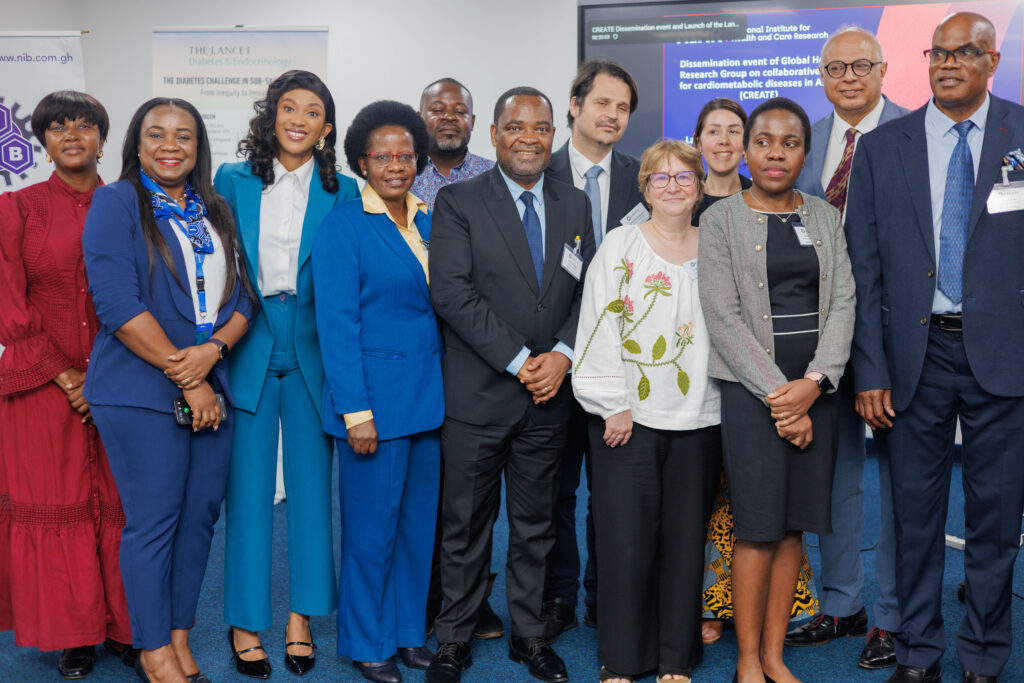
Professors Kamlesh Khunti and Sam Seidu led the event in Ghana on Monday, April 27, 2026, at the Accra City Hotel. It also marked the launch of a landmark, three-paper Lancet Diabetes & Endocrinology series on diabetes in sub-Saharan Africa.
In total, 39 delegates attended, including Chief Dr Doli-Wura Zakaria, Managing Director of the National Investment Bank (NIB), Ms Adjoa Oboubia Darko Opoku, Administrator of the Ghana Medical Trust Fund (MahamaCares), Dr Pascal Mwin, representing the WHO Country Office in Ghana, Dr Yakubu Seidu, CEO of Korle-Bu Teaching Hospital and Professor Alfred Yawson, Provost of the College of Health Sciences, University of Ghana.
Attendees heard about the CREATE programme, a four-year NIHR-funded initiative delivered through a partnership between the University of Leicester and institutions in Ghana, Kenya and Mozambique.
The programme focused on developing and testing integrated, person-centred models of care for cardiometabolic disease, alongside strengthening clinical and research capacity across settings.
A key achievement of the programme has been the development of the CREATE collaborative care model, designed to help health systems move away from fragmented services and towards more coordinated care for people living with diabetes, hypertension and related cardiometabolic conditions. The model has been piloted across Ghana, Kenya and Mozambique, empowering 261 participants through self-management education while generating evidence to support wider adoption across the region.
The programme also helped build long-term research capacity, training 10 early career researchers, more than 150 healthcare professionals and community health workers, and dozens of community champions who can continue supporting cardiometabolic care within their local communities.
Early career researcher John Tettah, who was offered a scholarship through the programme to study MSc Medical Statistics at the University of Leicester commented, “My story as part of CREATE reflects what becomes possible when opportunity meets potential.”
Professor Khunti, Principal Investigator of the CREATE programme, opened the event in Ghana and provided an overview of the programme’s aims, delivery and key outcomes, highlighting the importance of translating evidence into scalable, real-world models of care for people living with diabetes, hypertension and related conditions.
Professor Seidu outlined the key achievements from the programme and reflected on its role in strengthening capacity for cardiometabolic research and care across partner countries.
Speaking at the event, Professor Seidu also highlighted the importance of international collaboration in tackling shared health challenges, demonstrating how NIHR-supported researchers work across national boundaries to improve outcomes both globally and in the UK. Lessons learned through programmes such as CREATE have relevance not only for communities in sub-Saharan Africa, but also for improving the management of long-term conditions and reducing health inequalities closer to home.
Professor Henrietta O’Connor, Provost and Deputy Vice-Chancellor of the University of Leicester, also attended the event.
She commended the achievements of the CREATE programme, highlighting it as an example of the University’s world-leading research and its commitment to addressing global health challenges.
Professor Kara Hanson, Director of the NIHR Global Health Research Programme, said: “As traditional African health systems face a dramatic rise in non-communicable cardiometabolic diseases that threaten both public health and economic development, innovative approaches are more critical than ever.
“The NIHR-funded CREATE care model occupies this vital space, delivering the integrated solutions necessary to address this rapidly changing burden of disease.”
The event in Ghana also marked the formal launch of a three-paper series in The Lancet Diabetes & Endocrinology, published on Friday, April 24, 2026, bringing together evidence on diabetes in sub-Saharan Africa and outlining priorities for improving prevention, diagnosis and care.
Commissioned following the completion of CREATE, the series represents an important step towards scaling up the programme’s impact. Bringing together leading experts from Africa, the UK and international partner organisations, it provides evidence-based recommendations for strengthening diabetes care across the region.
A key recommendation of the series is for health systems to transition towards more collaborative and integrated models of care, such as CREATE, helping to build momentum for wider adoption and future investment. The publication is also expected to support new partnerships involving researchers and institutions from across Africa, Europe and the UK.
Discussions throughout the day highlighted the importance of translating evidence into policy and practice, strengthening health systems and sustaining international collaboration to improve outcomes for people living with cardiometabolic conditions.
More information about CREATE can be found at: www.createafrica.org.uk.